Learning · Chemistry
12 free chemistry games to learn the periodic table and reactions
Chemistry can feel like a wall of symbols at first: H, He, Li, Na… But behind those symbols is a pattern, and games are one of the friendliest ways to see it. Here are twelve free browser picks, from finding elements on a blank periodic table to building molecules and balancing equations.
All of them have calm, family-friendly themes. We have not finished every one, so the notes below are based on each game’s own page and a quick look. All links go to the official site, and Whyrium is not connected to any of them.
Learn the periodic table
- Interactive Periodic Table Game — you get a clue (a name, a symbol, an atomic number or a fact about the atom) and must tap where that element sits on a blank table. Start with the first 20 elements and work up to all 118.
- Element Hunt — a periodic-table Wordle. One element is hidden in each level and you have six guesses; each guess tells you if the atomic number is higher or lower and how close the group, period and family are. 118 levels, one per element.
- Bohr Blast — one level per element, from hydrogen to oganesson. Each atom is drawn as a Bohr model with its real protons, neutrons and electron shells, and you clear the nucleus by timing shots through the gaps between the electrons. After each level you get a fact card and a quiz question. Teachers can run timed class rounds with a code.
- Sporcle: Elements of the Periodic Table quiz — a classic timed quiz: type as many of the 118 element names as you can. Great as a weekly check to see how many you remember.
Atoms, molecules and equations with PhET
The University of Colorado’s free PhET simulations run in the browser and are made for school science:
- Build a Molecule — drag atoms together to make real molecules like water, carbon dioxide and ammonia, and see their names and 3D shapes.
- Balancing Chemical Equations — change the numbers in front of each substance until the atoms on both sides match. It includes a game mode with levels.
- pH Scale — test everyday liquids such as milk, coffee and soap, add water, and watch how the pH changes.
- States of Matter — heat and cool atoms and molecules and watch them change between solid, liquid and gas.
A virtual lab for older students
- ChemCollective Virtual Labs — a free collection of virtual lab problems from Carnegie Mellon University: pick chemicals from a stockroom, mix them in beakers and solve tasks on topics such as stoichiometry, acids and bases and solubility. Best for secondary school and up.
New chemistry puzzles on itch.io
- Re:ACTION — a match-3 puzzle where you swap and match atoms to collect the elements needed to make target molecules, with 20 levels and 17 molecules to discover.
- Periodic Sand — a falling-sand style sandbox with more than 100 substances, where you heat, crush and burn matter and mass and energy always add up. It needs a browser with WebGPU, such as a recent Chrome or Edge.
- Electron Clouds — rotate and zoom real electron clouds of 24 molecules, then try the quiz that asks you to name each molecule from its shape. Best for older students.
Tips for learning chemistry through games
- Start with 20. Learn the first 20 elements well before trying all 118. Most school chemistry uses them.
- Look for the pattern. When a game shows you an atom, count the outer electrons. Elements in the same column have the same number, which is why they behave alike.
- Count atoms on both sides. Balancing equations is just counting. Say it out loud: “two oxygens on the left, two on the right.”
- Link it to real life. After the pH game, ask which liquids at home are acids and which are bases.
- Short and often. Ten minutes a day of a periodic-table game beats one long session a week.
Try real experiments in Whyrium Chemistry
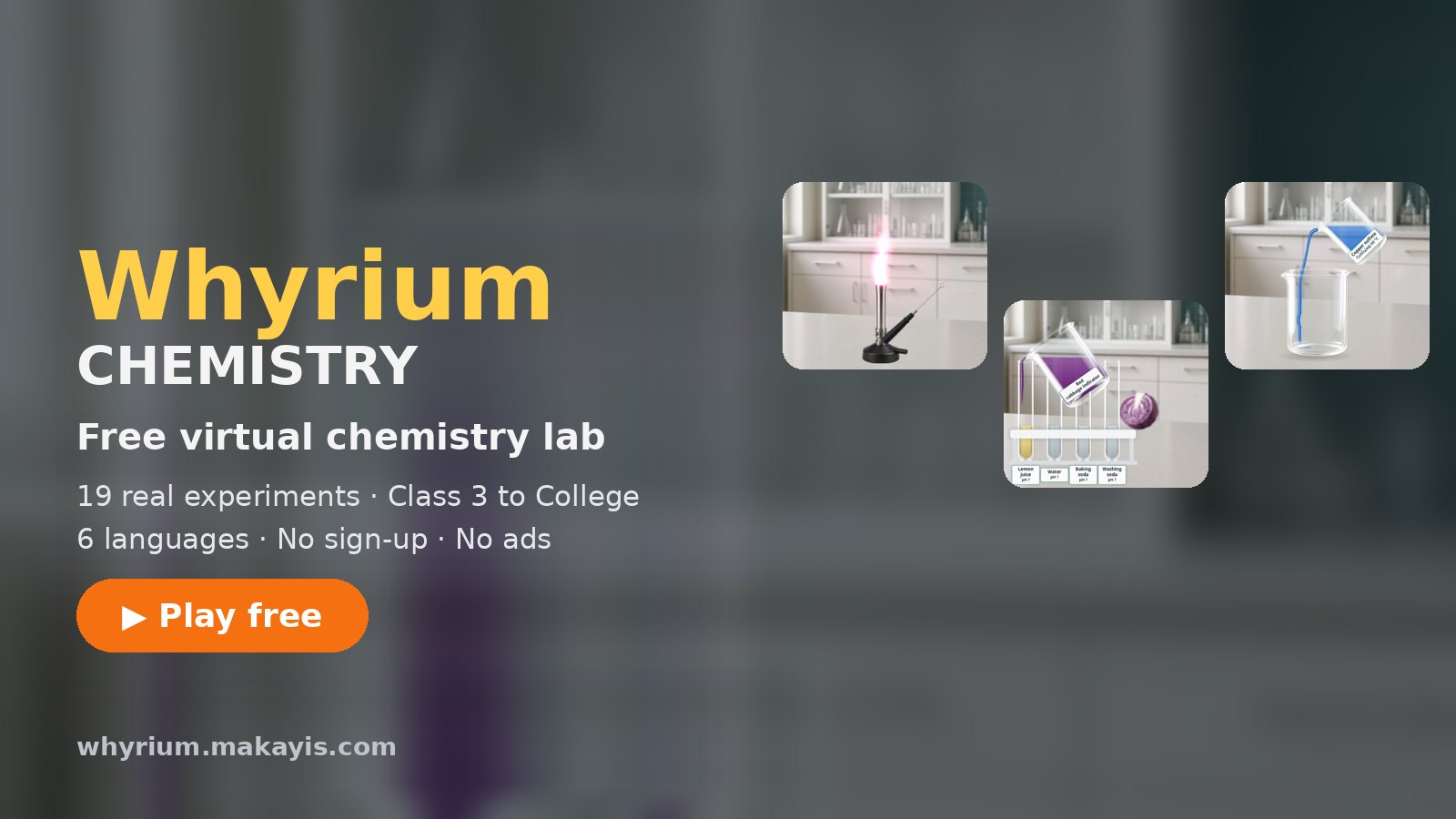
Ready to go from symbols to reactions? Whyrium’s free virtual chemistry lab Whyrium Chemistry lets you pour, mix and heat real chemicals in your browser and see the equation behind each reaction. Good first experiments: red cabbage pH indicator, flame tests and acid–base titration. If you like physics too, try Whyrium Physics.