A circle from slices
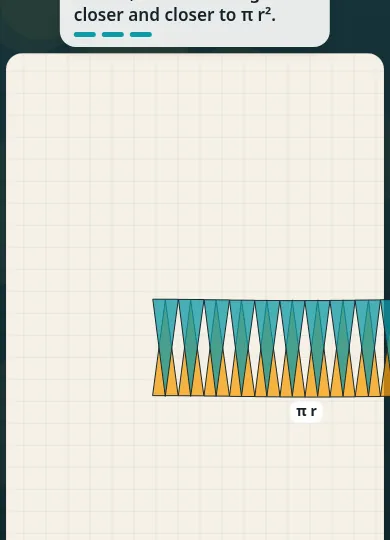
If you cut a circle into lots of thin slices and line them up, they make a shape almost like a rectangle. The long side is about half the circle’s around (π r) and the short side is the radius r, so the area is about π r times r.
π is the number of times the diameter fits around the circle, about 3.1416. Unrolling the circumference gives width 2πr / 2 = πr (because half the edges go up and half go down) and height r, so A = π r².
area of a circle = π × radius × radius
Why?
The regular n-gon inscribed in the circle has area (n/2) r² sin(2π/n). As n grows, sin θ / θ → 1 with θ = 2π/n, so the area tends to π r². The unrolled “rectangle” is the same n-gon, just rearranged.
College
Archimedes, in Measurement of a Circle, showed that the circle’s area equals a right triangle with legs r and 2πr, and squeezed π between 3 10/71 and 3 1/7 using 96-gons.
▶
- A circle is cut into slices, like a cake.
- Press Unroll. The slices line up into a bumpy rectangle about π r wide and r tall.
- Add more slices. The bumps flatten, and the area gets closer and closer to π r².
⭐ Fun fact: The first rigorous proof that A = π r² is due to Archimedes, more than 2,200 years ago.