Odd numbers make a square
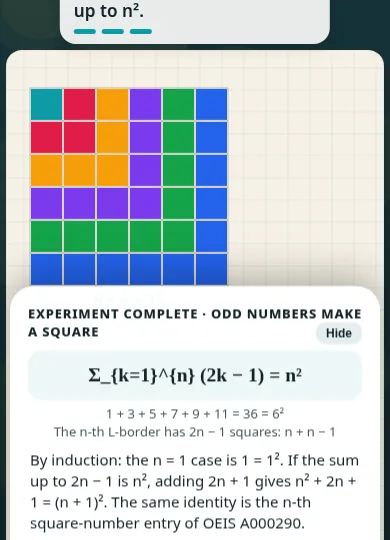
1 is a square. Add a bent row of 3 and you get a 2 by 2 square. Add 5 and you get 3 by 3. Each new L-shaped border is the next odd number, so adding odd numbers builds a bigger and bigger square.
The n-th odd number is 2n − 1. To grow an (n − 1) square into an n square you add a row of n − 1, a column of n − 1 and one corner: (n − 1) + (n − 1) + 1 = 2n − 1. So the L always fits, and the total is n².
the first n odd numbers add up to n squared
Why?
The picture works for a square of any size, so the pattern cannot stop. That is why 1 + 3 + … + (2n − 1) = n² for every whole number n, not just the one drawn.
College
By induction: the n = 1 case is 1 = 1². If the sum up to 2n − 1 is n², adding 2n + 1 gives n² + 2n + 1 = (n + 1)². The same identity is the n-th square-number entry of OEIS A000290.
▶
- Start with one square. Add the next L-shaped border.
- Each new L is the next odd number, and the shape stays a square.
- The first n odd numbers add up to n².
⭐ Fun fact: This is a classic “proof without words”. NRICH uses it with students aged 11–14 as “Picturing Square Numbers”.