Chance: coins and dice
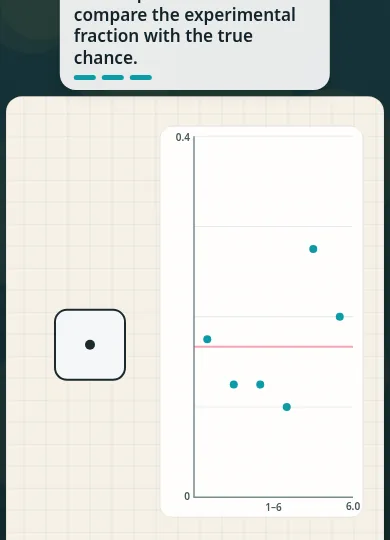
A fair coin has two equally likely faces, so the chance of heads is 1 out of 2. A fair die has six faces, so the chance of a six is 1 out of 6. If you try many times, the fraction of times it happens gets close to that chance — but it will not match exactly every time.
The theoretical probability assumes a fair coin or die. The experimental probability is (number of times the event happened) ÷ (number of trials). The two get closer as you do more trials, which is the idea behind the law of large numbers.
chance = number of equally likely favourable outcomes ÷ number of possible outcomes
Why?
If every face is equally likely, probability is a simple ratio of counts. Trials are independent: one flip does not change the next. Randomness means a short run can wander; a long run settles down.
College
For i.i.d. Bernoulli trials with success probability p, the sample mean p̂_n satisfies P(|p̂_n − p| > ε) → 0 as n → ∞ (the weak law). The standard deviation of p̂_n is √(p(1−p)/n).
▶
- Press Try once (or Try 20 times) to flip a fair coin. The more trials you do, the closer the fraction gets to one half.
- Now switch to the die and collect many rolls. A fair six-sided die lands on six about one time in six.
- You have enough trials on both experiments to compare the experimental fraction with the true chance.
⚠ Safety
This experiment is only about fair chances. It is not a game of betting or stakes.
⭐ Fun fact: A famous letter from Chevalier de Méré to Pascal in the 1650s helped start modern probability — as a way to understand fair chances, not just games.